
How to Incorporate Exercise into Daily Life
Finding time to exercise can be challenging, especially when you’re already juggling work, family, household responsibilities, and everything else life throws at you. But getting more exercise doesn’t necessarily mean spending an hour at the gym every day. There are plenty of ways to incorporate more movement into your daily life, often without adding another major commitment to your schedule. By looking for small opportunities to move throughout the day—and gradually adding intentional exercise—you can make physical activity a natural part of your everyday routine.
Affiliate Disclosure: This post may contain affiliate links. As an Amazon Associate, I earn from qualifying purchases at no additional cost to you. I only recommend books, products, and resources that I genuinely use, trust, or believe will be helpful. For more information, see my full affiliate disclosure here.
What Does It Mean to Incorporate Exercise Into Your Daily Life?
Physical activity is one of the 6 pillars of Lifestyle Medicine. The American College of Lifestyle Medicine recommends 150–300 minutes of moderate-intensity exercise each week, along with at least two full-body strength-training sessions. These are great targets to work toward, but if you’re currently getting little to no exercise, don’t feel like you need to jump straight to those numbers. Simply finding ways to move more throughout your day is a great place to start.
Walk More Throughout the Day
One of the easiest ways to get more movement into your day is simply to look for opportunities to walk a little more. You don’t need to set aside a dedicated hour for walking—small walks added throughout your day can add up.
- Walk after meals
- Walk while talking on the phone
- Take the dog for an extra walk
- Choose walking over driving when practical
- Park further away
Turn Everyday Tasks Into Opportunities for Activity
Moving your body doesn’t necessarily mean formal exercise. Lots of day-to-day tasks include movement.
- Gardening
- Housework
- Yard work
- Taking the stairs
- Carrying groceries
Get a Fitness Tracker
A fitness tracker isn’t necessary, but it can be a fun way to become more aware of how much you’re moving throughout the day.
Getting an Apple Watch was a game-changer for me. In a way, it helped me to ‘gamify’ my daily movement.
There are stand goals – where you can set goals to stand up and move for at least one minute out of every hour (you choose how many hours a day you want to do this, and your watch will remind you to stand up once an hour).
There are move goals – which is where you set your daily target for active calories you want to burn. This is above and beyond your basal metabolic rate, so you have to actively be moving in order to burn these additional calories. I keep mine set at 250 calories as a baseline.
Then there are exercise goals – where you do higher-intensity workouts, such as brisk walking, cycling, or weight training.
These are all presented as rings, and your goal is to close all 3 rings each day. You can set your own goals, and increase them when you want to.
Of course there are other fitness watches too – like Fitbit, or Garmin. We’re an Apple family, so Apple Watches work for us.
Break Up Long Periods of Sitting
One thing I love about my Apple Watch, is that it reminds me to stand up once every hour. Often, I get engrossed in computer work and forget to stand up and move! If you have a sedentary job, it would be a great idea to get up once every hour and simply walk around.
Since I work for myself from home, I like to spend 15 minutes of every hour on some kind of household chore. I set myself a 15 minute timer and do something around the house: wash a few dishes, switch laundry loads, water some plants, tidy up a messy area of my home, declutter a shelf, etc. Not only does it break up my sitting, but I’m always amazed at how much these little 15 minute bursts can accomplish for my home.
Try to think of some ways you can break up the time you spend sitting
- Take a movement break once every hour
- Walk around during phone calls
- Stand for some tasks instead of sitting
Find Activities You Already Enjoy
Sometimes we avoid exercise simply because it sounds boring. What are some activities you know you enjoy, that you could simply do more often?
- Dancing
- Hiking
- Gardening
- Cycling
- Walking with a friend
- Playing with your dog
- A favourite sport
Make Time for Intentional Exercise
Everyday movement is a great place to start, but it doesn’t replace intentional exercise entirely. Once you’ve built more movement into your day, you can gradually add structured exercise to help you build strength, cardiovascular fitness, mobility, and balance.
This doesn’t necessarily mean you have to join a gym if you don’t want to. You could simply go for a brisk 30 minute walk each day, and do some simple bodyweight exercises at home 2 times a week.
You could introduce:
- Strength training
- Cardio
- Mobility/flexibility
- Balance
We often think that if we don’t have a full hour to commit to exercise, that it’s pointless – but that couldn’t be further from the truth! Even 10-20 minutes of strength training or walking is a great starting point.
Start with Bodyweight Exercises
You don’t have to have a gym membership or even equipment to start strength training. Bodyweight exercises are a fabulous way to improve your strength! As you get stronger, you can gradually progress to more challenging variations.
Here are a few bodyweight exercises you can try:
- Chair squats — sit back toward a chair and stand back up
- Bodyweight squats — progress from chair squats as strength improves
- Wall push-ups — a very accessible starting point for pushing strength
- Incline push-ups — progress from a wall to a sturdy countertop or bench
- Glute bridges — strengthen the glutes and posterior chain
- Step-ups — use a low, stable step or stair
- Reverse lunges — can be added once basic squats and step-ups feel comfortable
- Calf raises — hold onto a wall or counter for balance if needed
- Bird-dog — develops core stability and coordination
- Dead bug — another beginner-friendly core exercise
- Plank — start with a wall or elevated surface before progressing to the floor
Check out the ACE Fitness & Exercise Library for more examples.
Slowly Accumulate Simple Exercise Equipment
Sometimes, the biggest barrier to exercise, is that we don’t want to make the trek to the gym. Maybe you don’t have time, or maybe you’re just cozy at home and don’t want to leave the house!
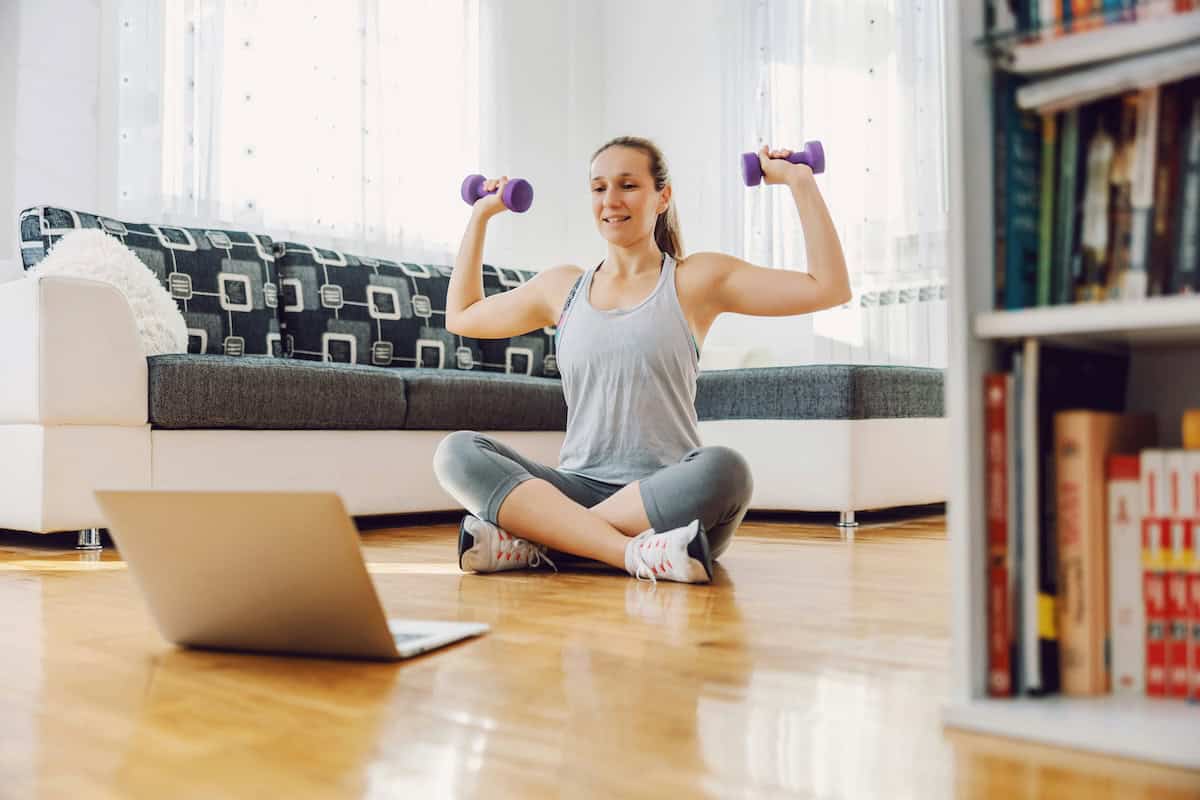
You can purchase some basic workout equipment to keep at home. You don’t have to have a full-on home gym, but having a few of these on hand will make exercise easier!
- hand weights
- resistance bands
- pull-up bar (for dead-hangs, pull-ups, knee lifts, etc)
- parallettes (to make push-ups easier)
- gymnastics rings
- yoga mat (I recommend natural rubber, which is non-toxic)
Make Exercise Easier to Start
Sometimes, we don’t exercise simply because we haven’t made it simple to start.
At our house, we have a pull-up bar in the doorway of the hall that leads to our bathroom. Every time we walk down that hall, we are reminded to do a few pull-ups or a dead-hang.
After I get home from the gym, I re-pack my gym bag and put it back in the car – that way if I happen to be in town running errands, I have no excuse for why I can’t stop at the gym and do a workout.
Here are a few examples of ways you can reduce barriers to exercising:
- Keep equipment accessible
- Keep your walking shoes by the door
- Put workout clothes on first thing in the morning instead of your normal clothes
- Put your workout days in your calendar
- Have a backup option for busy days
Find What Works for Your Life
Exercise is personal. If you’re having trouble getting started, ask yourself some of the following questions:
What type of movement do I enjoy? When do I have the most energy? What can realistically fit into my current life?
